Joshua Nahamya
06 March 2025
Mbarara City – Currently what one would think is impossible in Uganda in regards to acquired specialized treatment is possible at Mbarara Regional Referral Hospital [MRRH], says Dr Blessing Micheal, Consultant Neurosurgery of Brain and Spine at MRRH.
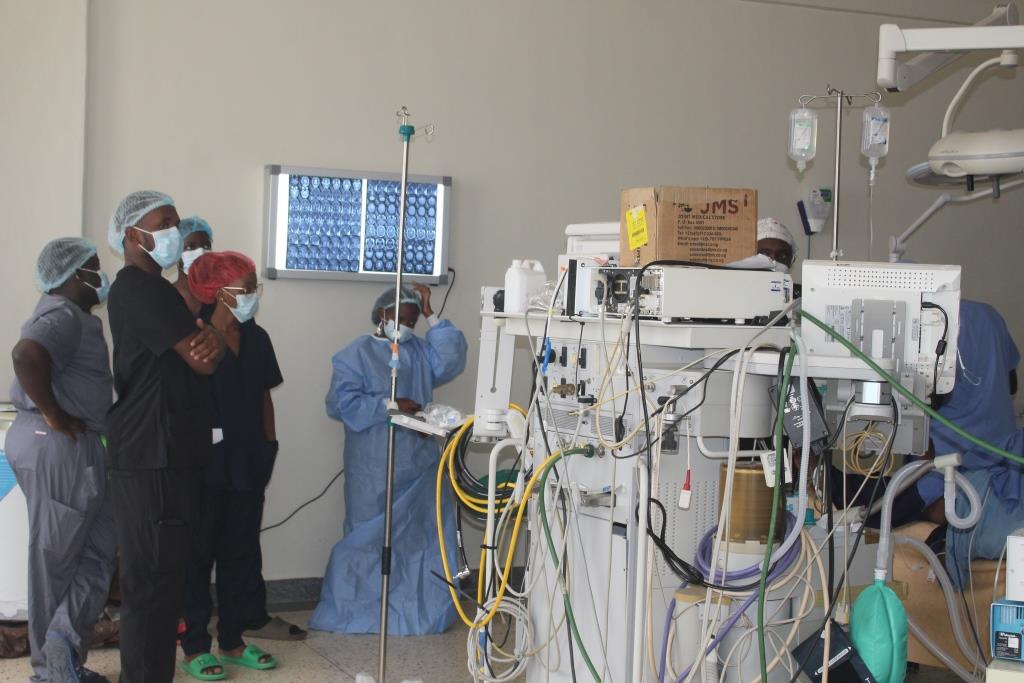
According to Taremwa, the journey of neurosurgery at MRRH started way back in 2015, but it was a shock for the journalists in Mbarara on Thursday, to witness a successful brain trauma surgery at Mbarara Regional Referral Hospital [MRRH].
“Today’s case, we have been doing complex skull based traumas which is one of the other super specialised neurosurgical conditions” Dr Micheal noted
He added that “in addition to this kind of surgery we’ve made, we are going to do more complex brain traumas using the image guided technology”.
“With the aid of the new technology we’ve talked about, we are able to treat brain traumas here at Mbarara regional referral hospital,” he noted
Dr Micheal said that this is a new technology that they never had before at the referral that any patient would wish to embrace.
Guided by super sophisticated equipment such as magnetic resonance imaging (MRI) and microscopes among others, neurosurgeons at MRRH, were able to operate brain traumas through the nose.
“Surprisingly we do not open the head; we use a microscope which is a new technology that we’ve acquired to pass through the nose which is less disruptive to the patient,” he stated
“Like this patient that we have just operated on had a skull-based trauma that required a very complex surgery, but she is going to go home within two to three days because of the approach that we used without necessarily going through a dissection operation to operate this brain trauma,” Micheal added.
He said, “In the previous years, for example, diagnoses such as CCT scans and MRIs were scarce, not easy to obtain and they are also quite expensive”.
“With the coming of more technology in the country, it has become more available and more affordable and hence patients who have had neo-surgical conditions have been able to have proper diagnosis with proper investigations and hence able to arrive at a correct treatment point,” Micheal explained.
Dr. Micheal said that they started by doing simple non-surgical operations until 2020 when they received special equipment to carry out specialized and super specialised non-surgical treatment.
“Specifically for the last 3-4 years, we acquired a complex technology. This has been a concerted effort from the developed world that is the United Kingdom and United States of America whereby these people have managed to help us with equipment such as neo-surgical drills, new surgical microscopes, and the government providing us with space,” he explained.
Micheal said that the new technology basically helped us to advance in terms of complexity and also in terms of the speed of doing these surgeries.
“In 2015, we started by doing simple neo-surgical operations but with the development of the new technology; we’ve been able to advance in terms of complexity of the surgeries and increase the number of operations” adding that, currently we operate over 600-700 complex neo surgical cases in a year and previously we would operate between 200-250 cases per year.” He stated
Causes, signs & symptoms of brain trauma
Dr Micheal said that neo-surgical conditions are quite rampant, especially as a result of road accidents and other congenital conditions mostly among children such as hydrocephalus associated with big heads and myelomeningocele which are openbacks. “Neurosurgical conditions are quite diverse in the country and they are presented in many ways”
He explained that for one to suspect brain trauma, a person will present with severe headaches, strokes, and back pain thus calling upon people to always go for tests at an early stage for proper management.
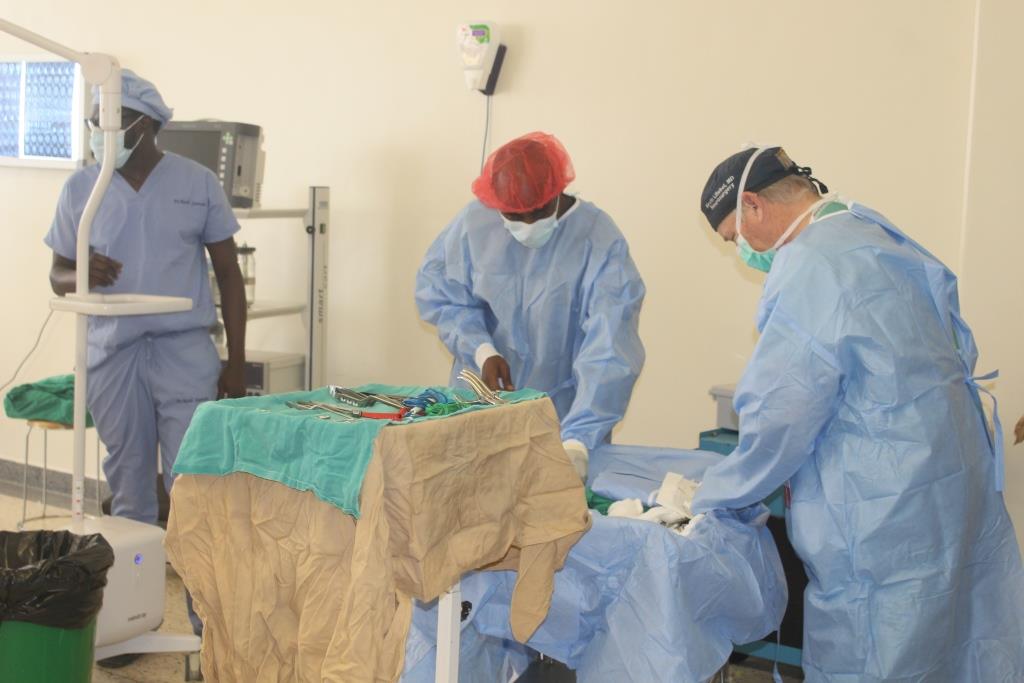
unearthed Brain trauma operation using specialised technology at MRRH
“For the public to know that a person has a high level suspicion of neurosurgical problems from the symptoms that I have just mentioned above, one should seek medical attention from trained medics that will guide correct investigation, correct diagnosis and correct treatment plan.” Micheal said
Challenges
Despite the successful skull trauma operations, Micheal says that Mbarara referral hospital still has a long way to go thus urging the government to provide more equipment regarding super specialized treatment.
“We are very far behind compared to the western medical care but at the same time we have to appreciate ourselves from where we have come from to give ourselves courage to pursue more progress in health care because even in developed world, so many decades ago they were not developed like the way they are now,” Micheal noted
He added that the doctor-to-patient ratio of neurosurgeon numbers is still low, urging more students to pursue neo-surgery training.
“The demand of neurosurgical services is still very unmatched in terms of the service providers specifically the neo surgeons- the team in the critical care, the neo surgical nurses and other support staff, we are still having very high demand with a very few personnel to satisfy this demand,” he said
“At the moment we are over 50mln Ugandans and ideally we need a ratio of one neo-surgeon to maybe 20,000 Ugandans but at the moment I have to say that we have one 1 neo surgeon to about 3mln Ugandans that is a challenge that needs to be addressed,” Micheal added.
He confirmed that such specialized treatment is free of charge unlike in the past when people would fly abroad to seek such specialized care at a high cost.
“A couple of years ago, these surgeries were not offered in the country. People had to travel to countries like India where they would spend lots of money over 50,000 US dollars but now it is a blessing that we successfully offer such services here at Mbarara Regional Referral Hospital in the country at no cost because MRRH is a government public facility where its services are free.” Dr. Micheal explained
Dr Joseph Ssembatya, a resident of neurosurgery at MRRH welcomed the collaboration between Mbarara regional referral hospital medics and the United States of America, whereby they are getting training and reading their journals to improve on neurosurgical care.
“As Mbarara regional referral hospital, we are privileged to have this kind of technology starting from Mbarara. As a resident, I take this privilege to have such people come and transfer the skill to us so that we get used to the modern way of technological treatment to ensure that our patients’ safety on such complex cases,” Ssembatya said
“We are reading most of their literature and research, and we have started doing some of our research here and publishing our own literature slowly moving in their footsteps to reach there.” He added
Dr Kevin Lillehie from the Department of Neurosurgery at the University of Colorado said that Uganda needs to invest big in neurosurgery based on the number of cases in the region.
“For the last two years I have spent in Uganda, neo surgery is important given the number of brain trauma, strokes and spine problems that happen to patients in this region. Neurosurgeons are much needed and the group here at Mbarara here has a very significant role to play.” Lillehie noted
Dr. Ryan Ormond, also a neurosurgeon from the University of Colorado, confirmed that his role during the specialized operation was specifically to help operate the ultrasound in the brain and guide the surgery to help visualize the brain and traumas in the brain.
“We are excited for this successful operation. Let’s keep collaborating together to improve the care of medical care of Uganda Mbarara in particular,” Ormond said
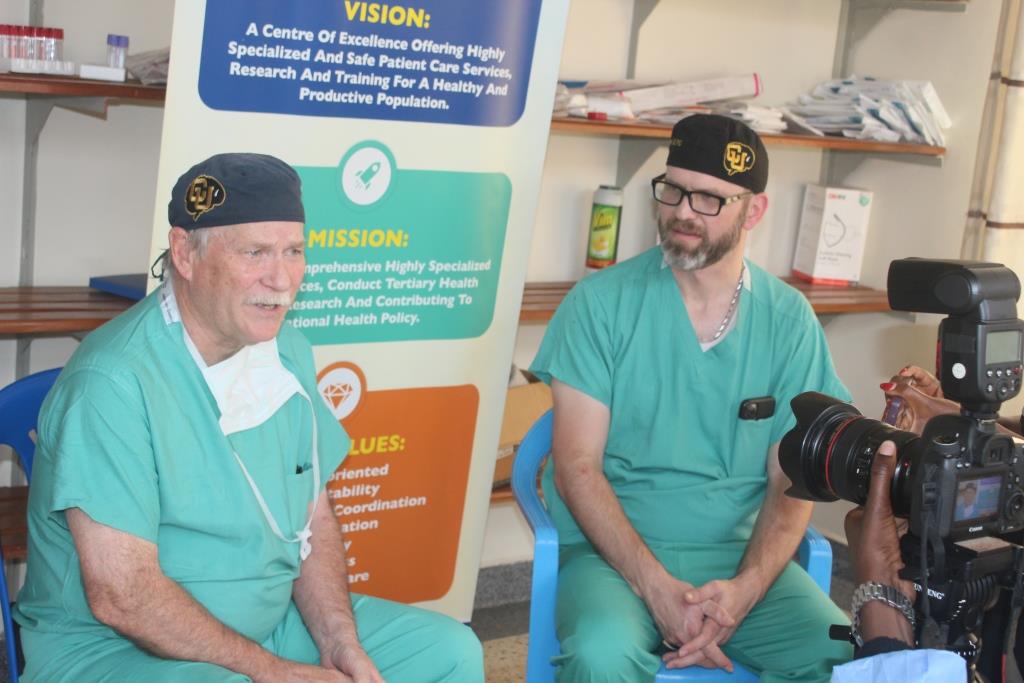
Dr Lillehei & Dr Ormond-Chief specialists at MRRH on neuro surgery operations
He attributed the significant change of medical treatment to medics’ training both within and outside Uganda thus commending doctors in the country for embracing new technology.
“I think the future of neurosurgery is very bright. If you look back 10 years ago, the quality of medical care has significantly improved compared to what they were using in the past” Adding that, this is a combination of the training of neurosurgeons within the country and outside Uganda that medics have been able to embrace new technology” Ormond emphasized.
He challenged medics, especially neo-surgeons, to embrace training if they were to master the game of new technology. “Training is key and they can benefit from having many neurosurgeons in the country because there are much higher trauma cases arising from accident crashes here”
Dr Ormond however decried the low number of neurosurgeons compared to the huge population of Uganda. He said that Homorganic stroke is 2-3 times higher in East Africa especially among children because of infectious diseases thus calling for urgent attention.
“I believe there is something like 22 neurosurgeons in Uganda right now for a very large population. So if you want to develop health we recommend one neo-surgeon per 100,000 populations at least” Adding that, there is a need for more training for neo-surgeons in Uganda,” he said
“Trauma diseases are higher in the population and the number of neo surgeons to treat the population is much lower. So it is a struggle at both ends whereby there is a much higher disease burden in Uganda compared to the much smaller workforce of specialists to help on such diseases,” he noted
He added that medics in Uganda face a limitation of lack of resources to tackle public health diseases like hemorrhagic stroke and high blood pressure where the government should intervene.
“In East Africa basically the quality of neo surgeons in Uganda is very good. They can deal with many diseases using the little resources they have but if they are able to get the resources that they want maybe through the government partnership I don’t but I think there is a limitation they are facing here.” Ormond explained
Professor David Kitya, the founder of surgery at Mbarara Regional Referral Hospital in January 2012, thanked the collaborators who have enabled the hospital to expand the surgery spectrum by providing them with equipment and grants for research.
These include; Cure Children’s Hospital, Mulago Hospital, and Duke University among many others.
“They have been very helpful in our journey and now we participate in neo surgery clinical services including outreach services and mobile services in the region and I can tell you the demand for neo surgical care is increasing every year,” Kitya said
He challenged politicians and high-profile people in the country to stop wasting money going for operations and rather use the facility here in Mbarara.
“The culture of Ugandans we think that good things are always not at home. You find most people running to be treated in Kampala, Nairobi, and India when such services can be got from Mbarara here” Adding that, this is a call to our patients let’s use our medics here for super-specialized treatment.” Dr Kitya stated
According to Halson Kagure, Public Relations Officer, Mbarara Regional Referral Hospital has co-existed with Mbarara University of Science and Technology since 1989 to feed medical students and specialists into the hospital, an objective that has happened over time.
He said that MRRH is the only regional hospital out of the 17 regional referrals that offer both specialised and super-specialised health care.
These include; neurosurgery, urology, paediatric surgery, cardiology, ophthalmology, plastic surgery, dermatology, orthopaedic surgery, cardiothoracic surgery, and pulmonology services among others.