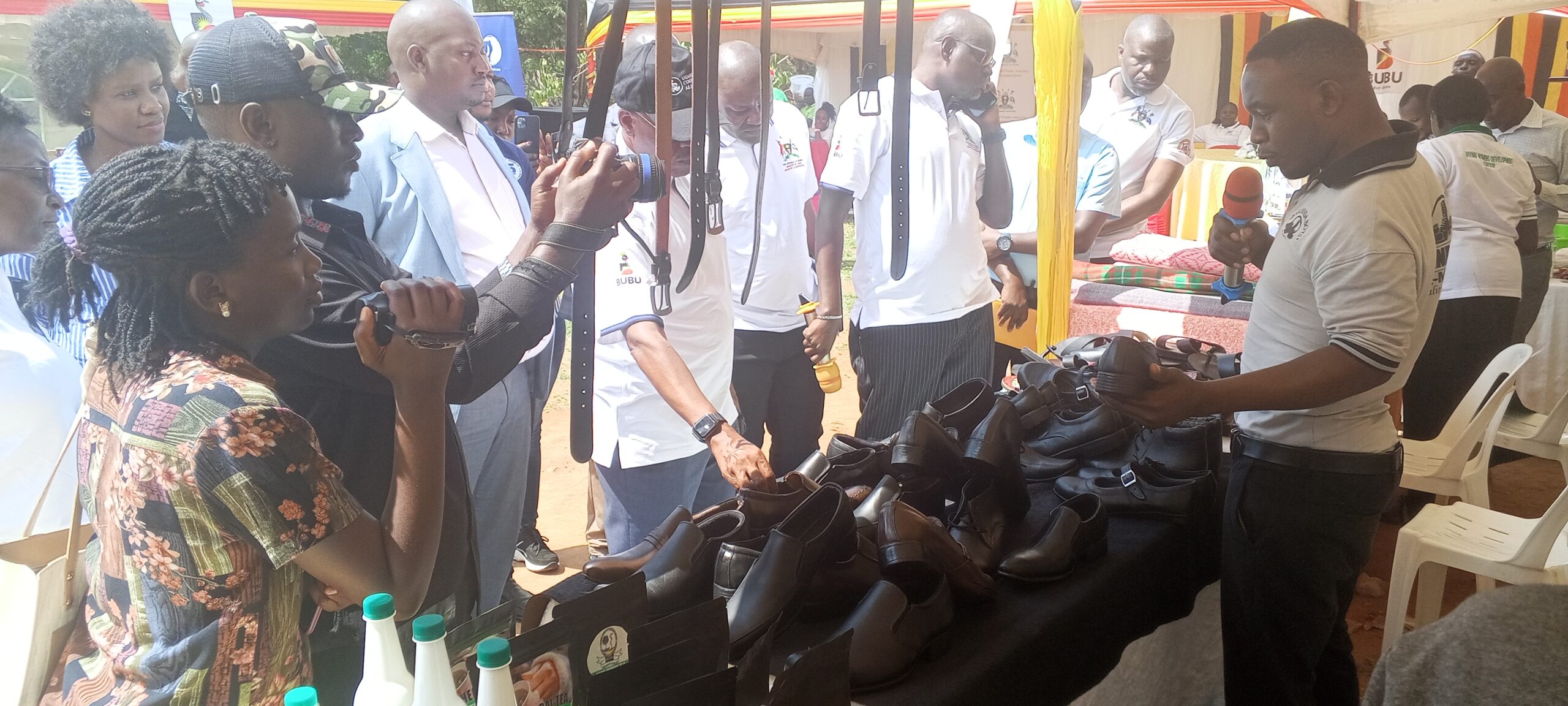
BUBU expo flourishes in Mbarara, entrepreneurs decry UNBS double certification
Joshua Nahamya
04 July 2025
Mbarara City – Julius Bigabwa, proprietor of Big Lad Agro, an agro-ecological mixed farming Tourism Farm in Fort Portal Tourism City, and a pioneer in macadamia cultivation in Uganda, has challenged the Uganda national bureau of standards [UNBS] over the double certification he decried of chasing entrepreneurs from business.
During the recent Buy Uganda build Uganda [BUBU] expo in Mbarara city, Bigabwa showcased an array of items he gets from macadamia, despite being a relatively new crop in Uganda, but one with immense potential.
“Macadamia is an expensive crop, and so are all its products,” Julius explained, showcasing edible nuts, highly prized macadamia oil (a liter costing a staggering Shs 100,000 due to its omega fatty acids and health benefits for heart problems), rich macadamia butter, organic cosmetics, and even macadamia milk and honey,” he noted
However, despite his innovative spirit, Bigabwa’s biggest hurdle wasn’t cultivation or production; it was product certification by the Uganda National Bureau of Standards (UNBS), as he recounted the challenges he undergoes.
“We use one raw material, the macadamia nut, to get all these different products,” he stated, “but UNBS only certifies one product at a go. Why should I get separate certifications for oil, butter, milk, and cosmetics when they all originate from the same nut, especially when someone eating the raw nuts doesn’t face skin reactions, but an oil or butter made from the same nut is deemed risky?” he questioned
Bigabwa also highlighted the disparity and discrepancies faced by the local entrepreneurs for not having a quality (Q) mark from NBS.
“Whoever takes a step to pack something, UNBS comes for you. My macadamia butter is like pounded groundnuts, yet street vendors sell unpackaged groundnuts freely, while UNBS confiscates our packed products from supermarkets.” He pleaded for a temporary exemption for SMEs, stressing the high costs involved.
“We’re packaging, branding, and employing educated people, so the costs are already high. Application for a UNBS quality mark alone is Shs 500,000, and tests can cost around Shs 900,000. You need about Shs 3 million to succeed with certification. How can a new entrepreneur starting with just one million shillings afford this cost?” he further asked.

Bigabwa exacerbated the issue of the few UNBS regional offices in the country, which makes it inaccessible and expensive to get the standard mark.
“When you go to Toro region, we don’t have a UNBS office,” Julius lamented. “We have to go to Mbarara, and for microbial and nutritional tests, we still have to travel all the way to Kampala. These costs kill us before we even start business.” He lamented
UNBS Response to concerns
Ivan Mugume, Customer Care Officer at UNBS, provided clarity on the certification process. “We certify based on independent standards for every product,” he explained. “We look at the end result, not just the raw material. The raw material may be the same, but the processes leading to the final product are not. Therefore, the final products cannot be the same, and that’s why they need separate certification.” He explained
Mugume emphasized the importance of safety and avoiding health risks. “For example, a pure cosmetic versus a perfumed one is two different products and must be certified differently. Some individuals are allergic to perfumes, and if we certify them as the same product, it becomes illegal and UNBS would be liable as the regulator.” He reiterated that UNBS focuses on the ingredients, the processing, and even the packaging to ensure the quality and safety of the product to be consumed.
Robert Mugabe Kakyebezi, Mbarara City Mayor, praised the Ministry of Trade for bringing the BUBU expo to the region, encouraging local producers to focus on networking and marketing beyond immediate sales. Crucially, he urged local manufacturers to form cooperatives (SACCOs).

“If you want to benefit much from the government, you must organize yourselves into SACCOs and groups. Register them to be legally known, so that when the government considers support, it can easily channel funds.” Kakyebezi noted
Justus Katusiime, another entrepreneur from Mitooma district, brought a historical perspective to the discussion, lamenting the government’s laxity in reactivating traditional cooperatives.
Katusiime urged the Ministry of Local Government to integrate economic empowerment programs like the Parish Development Model with these established cooperative structures.
“The government has the will to revive the traditional cooperatives as it is placed in its NRM manifesto, but there’s a lack of enough information regarding these cooperatives.” He emphasized that pioneers like Keith Kabacenga, who started Banyankole Kweterana Co-op Union in 1958, were already champions of value addition and local industrialization.
Katusiime also called for regional consultations to align government policies with the realities on the ground concerning cooperative regulation.
General Mbadi Mbasu Wilson, the Minister of State in charge of Trade, representing the Minister of Trade, Industry, and Cooperatives, officially opened the expo, emphasizing the critical role of Micro, Small, and Medium Enterprises (MSMEs) in Uganda’s economic growth. He echoed the Mayor’s call for collective action.
He highlighted that the BUBU expo served as a crucial platform for dialogue, revealing both the entrepreneurial spirit driving Uganda’s economy and the systemic challenges that require collaborative solutions from both the private sector and the government.
“Recently, I was in Indonesia and found they have 69 million MSMEs, but here we still like working as individuals, that’s why we get most of the challenges.” He explained that MSMEs account for 90% of Uganda’s private sector and employ 2.5 million Ugandans, primarily youth and women. “When they are organized, it is easy for the government to direct its efforts,” said Wilson
Government’s Way Forward and Commitment
The Minister acknowledged the challenges faced by MSMEs, including inadequate compliance with standards, limited access to affordable financing, and poor production technologies. He outlined the government’s interventions:
- Regional Laboratories: UNBS has established a regional laboratory in Mbarara, with plans for at least two more in the region to bring testing services closer to MSMEs. UNBS’s budget has also been significantly increased to enhance its efficiency.
- Value Addition Equipment: The ministry, through its rural industrialization strategy, has provided modern value addition equipment across regions for facilities like milk processing, carpentry, and juice processing.
- Affordable Financing: The government is capitalizing on the Uganda Development Bank (UDB) and UDC to enable businesses with bankable projects to access cheaper funds.
- Enabling Infrastructure: Investments in better roads and electricity, with a target to reduce electricity costs to five US cents per unit, aim to lower the cost of doing business.
- Technological Incubation: The Uganda Research Institute (URI) will serve as an incubation agency to help MSMEs access better technologies.
- Preferential Procurement: The Public Procurement and Disposal of Public Assets Act (PPDA) has been revised to offer preferential treatment to local contractors and suppliers. Foreign firms on government projects are also encouraged to partner with local companies for skill and technology transfer.
The minister stressed the importance of standards for market access. “The Japanese are very particular about standards,” he noted. “Those who say they have products but no market, just work on the standards. UNBS certification is part of your investment,” adding that, if this were a UNBS surveillance exhibition, I am sure many of these products here would be declared counterfeit because of not having the standard issue. So these issues you are calling challenges, must be turned into opportunities so that we can access the market,” Wilson stated
He further highlighted the vast market potential—Uganda, the regional East African Community (300 million people), COMESA (670 million people), and the African Continental Free Trade Area (1.4 billion people). “We have the market, and now we have the products. The only thing we need to do is to comply with the standards.”
“We also signed an agreement with the Africa Continental Free Trade Area, which has a population of about 1.4 billion people, with a market value of about 3.4 trillion U.S. dollars. So how can you say we don’t have the market? We have the market, and now we have the products. The only thing we need to do is to make sure that we comply to the standards where we can export these products,” Wilson noted
He also reiterated the need for cooperatives, thus appealing to exhibitors to address the question of quantity to satisfy the market. “Market means accessing it and sustaining it. You individuals must think about whether you can sustain the market with small quantities or if you need to come together as a cooperative group.” He stated
According to the Microeconomics and Fiscal Performance Report of Financial Year 2023-24, released by the Ministry of Finance over the past decade, Uganda has recorded steady growth in trade performance with total exports doubling from US dollars 4.4 billion in 2020 to 8.5 billion in 2024.
“This upward trend reflects the country’s strength of trade systems and the resilience of its private sector. Today, trade contributes an estimated 43% to Uganda’s GDP, which I think we want to push to 50% because no country has ever developed with less than 50% trade to its GDP,” Mbade reported.
Uganda now generates 20% of the tax revenue, making it one of the most significant pillars of its economy. “So, this BUBU Expo further promotes togetherness to promote two most important policies that we think will play a critical role in the economic growth of Uganda, that is, import substitution and export promotion. BUBU’s policy and strategy have also improved market access for local products, because currently local products now occupy 56% of the supermarket shelf space from 20% in 2015, although much of it is not certified.
Also, government procurement of local products has increased to 60% from the target of 20% in 2015. Compliance of local products to standards has also increased, and as far as sectoral achievements are concerned, in the construction sector, they have been most beneficial through subcontracting and public works. Opportunities mainly stem from public procurement, especially in road infrastructure projects. There have also been significant benefits seen in pharmaceuticals and textiles.
“As a result of BUBU, there has been growth in local manufacturing and investment for example, we now have 82 new bottled water industries established. You will find Aqua, you will find Uzima, and so many of them around here, because you know water is life. Also 209 sanitiser factories and 29 face mask factories have been set up. Two new steel rolling mills, three tile factories and three cement factories have been established. There is one new salt factory, Kampala Salt Industry and Infrastructure Development Limited, and we also imagine local production in electronics. Increased capacity in steel rolling capacity grew from 886,000 metric tonnes to 1.7 million metric (15:46) tonnes per year,” Wilson explained.
He added that as a result of BUBU, there has also been a reduced trade deficit. “For example, the tiles import bill dropped by $6.28.5 million. Tiles export earnings increased by $6.3.5 million.
“As I conclude, ladies and gentlemen, through BUBU, we can further achieve better trade performance and competitiveness by supporting MSMEs in the coffee, tea, fish, maize, sugar, fruits, vegetables, and hot culture sectors, among others, from this region for export promotion.”
“I therefore want to call upon you to take advantage of such expos and forums to engage the government in promoting our own products as we address the challenges that come with this promotion,” Wilson said
“I also want to commit that our inclusive support as a ministry of trade to promote our local products and services through the implementation of BUBU policy and strategy for import substitution and export promotion will always be felt. And as MSMEs, you focus on the issues of standards for you to be able to thrive. Let’s walk the talk, adding that, if we say that the MSMEs are the backbone of economic growth, then let’s do those implied tasks that make them feel so.” He added